"I was practically born on a horse"
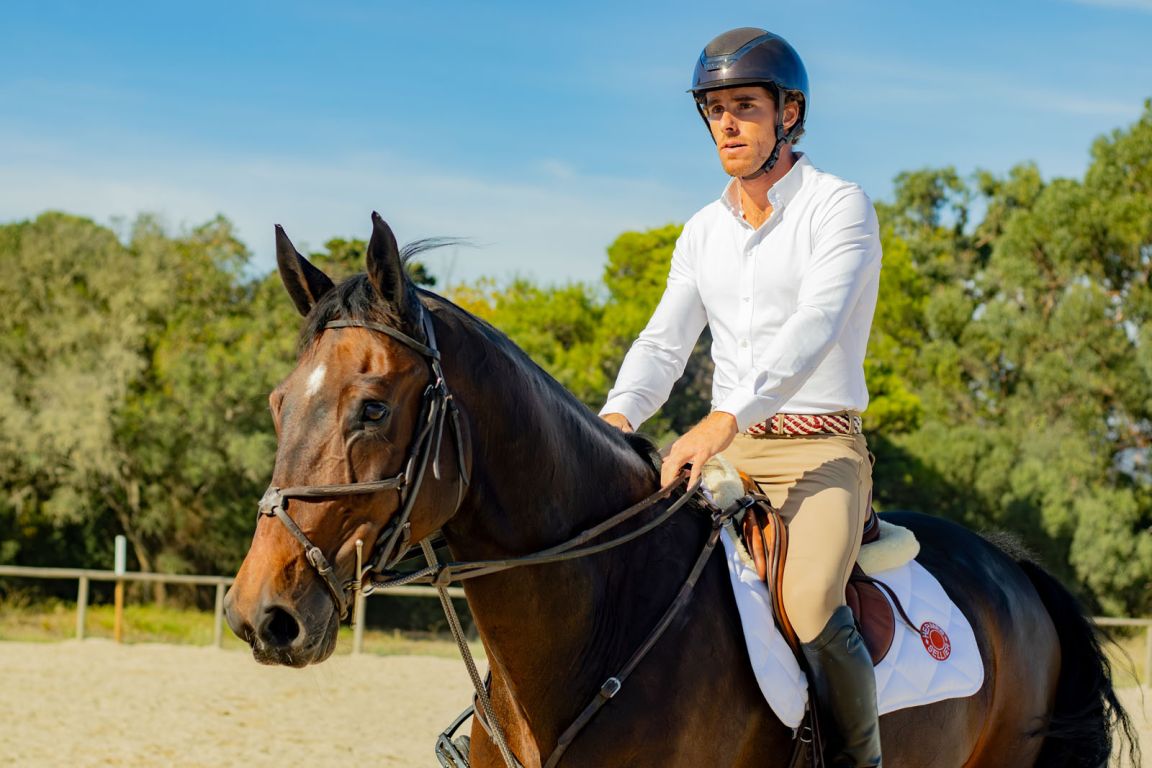
From his very first contact with the equestrian world, Alexandre Mascarenhas de Lemos knew his destiny would unfold between arenas and bridles. Heir to one of Portugal’s most respected horsemen, he shares with his father both the name and the passion for horses – yet he is determined to carve his own path.
When did you start riding, and at what point did you realise you wanted to pursue a career as a show jumper? Was it something that came naturally through family heritage, or a personal choice?
I often say I was practically born on a horse. I started riding at eight, strongly influenced by my father and my brother Salvador, who already lived the equestrian world with great intensity. At home, horses were a constant theme — part of the routine and the family’s imagination. I remember my first pony, Dalton, with great affection. It was with him that I learned the value of trust and surrender, principles that still guide my relationship with every horse.
Following this path was, at the same time, natural and deeply conscious. Living with the sport, its technical demands, and my father’s passion showed me that I wanted to dedicate my life to this art — the art of creating, understanding, and competing in perfect harmony with the horse.
Sharing your father’s name and following in the footsteps of an established rider, do you feel pressure or inspiration? How do you handle comparisons between generations?
Sharing my father’s name is both an honour and a commitment. I grew up observing his discipline, his attention to detail, and his absolute respect for the horse — values I strive to carry into my own way of being. Comparisons are inevitable, especially because sometimes we even ride the same horses. But I see them as a form of recognition. To be compared to a rider with my father’s experience, vision, and career is, to me, a compliment.
More than feeling pressure, I seek inspiration. His career is both a technical and human reference, and my goal is to add my own dimension to that heritage, with the same seriousness and ambition for excellence.
Tell us about your most important horses, past and present. Which one do you share a special connection with? Is there a horse you’re particularly focused on developing in the coming years?
Over the years, I’ve been fortunate to ride very different horses, but Classico 70 holds a special place. From the very beginning, we developed an almost intuitive connection — a silent language that requires no excessive gestures. He’s a 12-year-old horse, son of Chin Chin and Caretino, with a rare combination of energy, sensitivity, and intelligence. Inside the arena, he shows great power and focus; outside, he’s gentle, attentive, and radiates a calming serenity.
Classico regularly competes in 1.45m and 1.50m Grand Prix events and is undoubtedly one of the most complete horses in the circuit. My goal is to continue developing his talent, consolidating victories, and climbing the FEI ranking. What fascinates me most is that every technical improvement stems from mutual trust — that’s what turns sport into art.
We know you’re also involved in activities outside equestrian sport. How do you balance those worlds with the demands of training and competition?
Physical and mental preparation is a natural extension of technical training. In the gym, I work on balance, stability, and mobility — key pillars for precise riding. I practice kickboxing to develop focus, endurance, and reaction speed. It’s both a physical and mental exercise, very similar to what happens in the arena: every movement counts, and timing is everything.
I deeply believe that the horse reflects the rider’s inner state. That’s why I maintain a rigorous routine, allowing me to approach my work with the clarity and energy that high-level sport demands. In my downtime, I like to read and stay connected to what’s happening in the world.
Where do you see yourself in five to ten years within the world of show jumping? Are there international competitions, titles, or partnerships you aspire to achieve?
My focus is on competing at the world’s most prestigious events: CHIO Aachen, CSIO Spruce Meadows, CHI Geneva, and The Dutch Masters. These are competitions that represent the emotional and technical summit of our sport. In parallel, I want to keep asserting myself in the Global Champions Tour, which brings together the world’s elite and demands extraordinary consistency throughout the season.
But success in show jumping is, by nature, a team effort. The rider is only the visible face of a complex structure: the groom, the farrier, the vet, and the trainer all play essential roles. Precision and trust between everyone are fundamental. I like to think my work is like the mechanism of a Swiss watch — every gear must move in perfect synchronization so the whole achieves absolute precision. With that philosophy, and with the dedication of my entire team, I believe the future will be built step by step, with rigour, courage, and vision.
What message would you like to leave to young Portuguese riders who see you as an emerging reference? What legacy do you hope to leave in equestrian sport and in how the discipline is developed in Portugal?
sport and in how the discipline is developed in Portugal?
I believe that a true horseman is defined by the way he understands and respects his horse. That relationship is the essence of our sport. I try to be an example of consistency, dedication, and coherence — qualities that, more than natural talent, determine the longevity of a career.
I want to create a program called Next Generation Riders, aimed at supporting young Portuguese riders by offering training, technical guidance, and international opportunities. There’s tremendous potential in Portugal, but we lack the structures to turn that passion into a clear path. I want to help change that. More than titles, I hope to leave a legacy of excellence, authenticity, and a genuine love for the horse — because that’s where everything begins and ends.